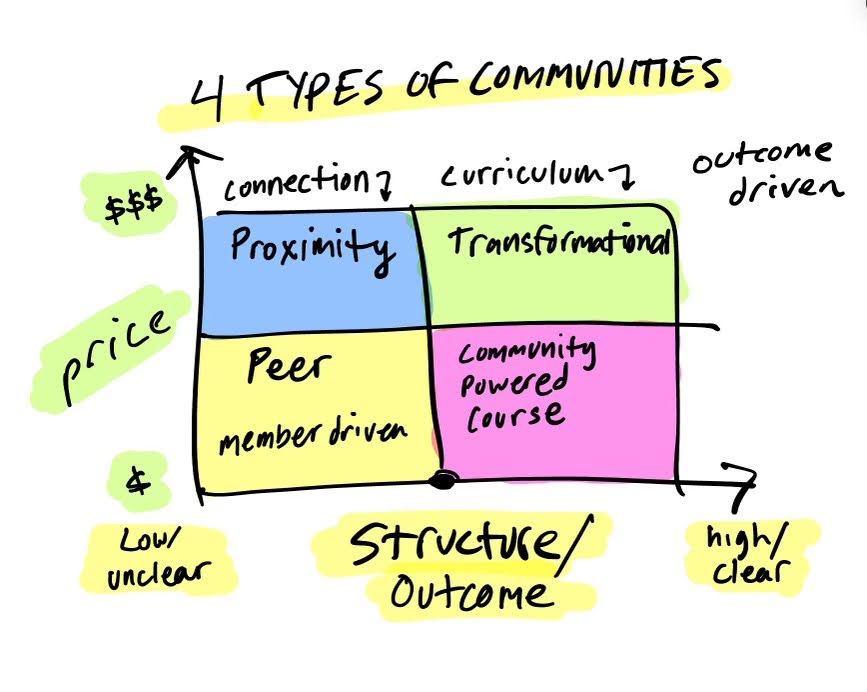
Ever wonder why some online communities charge $20 a month while others cost $2,000? This chart breaks it down perfectly. It shows how structure and connection drive both value and price.
Marketing Analysis
The Y-axis is price, and the X-axis is structure or clarity of outcome. Communities with clear outcomes and stronger frameworks sit higher on the value ladder. “Transformational” and “Proximity” communities are expensive because they promise either major results or powerful networks. “Peer” and “Community-Powered Course” groups stay cheaper by relying on participation, not structure.
Why It Works
- People pay for clarity—defined outcomes feel safer.
- Connection = perceived access = higher value.
- Structure reduces uncertainty, increasing willingness to pay.
- Transformation > information—results command premium prices.
Examples
- Y Combinator (Proximity): exclusive network, high price, massive outcomes.
- Chief (Transformational): women leaders community, $7K/year.
- Indie Hackers (Peer): free, member-driven.
- Maven courses (Community-Powered): cohort-based, structured learning.
Analyzed by Swipebot
Loading analysis...