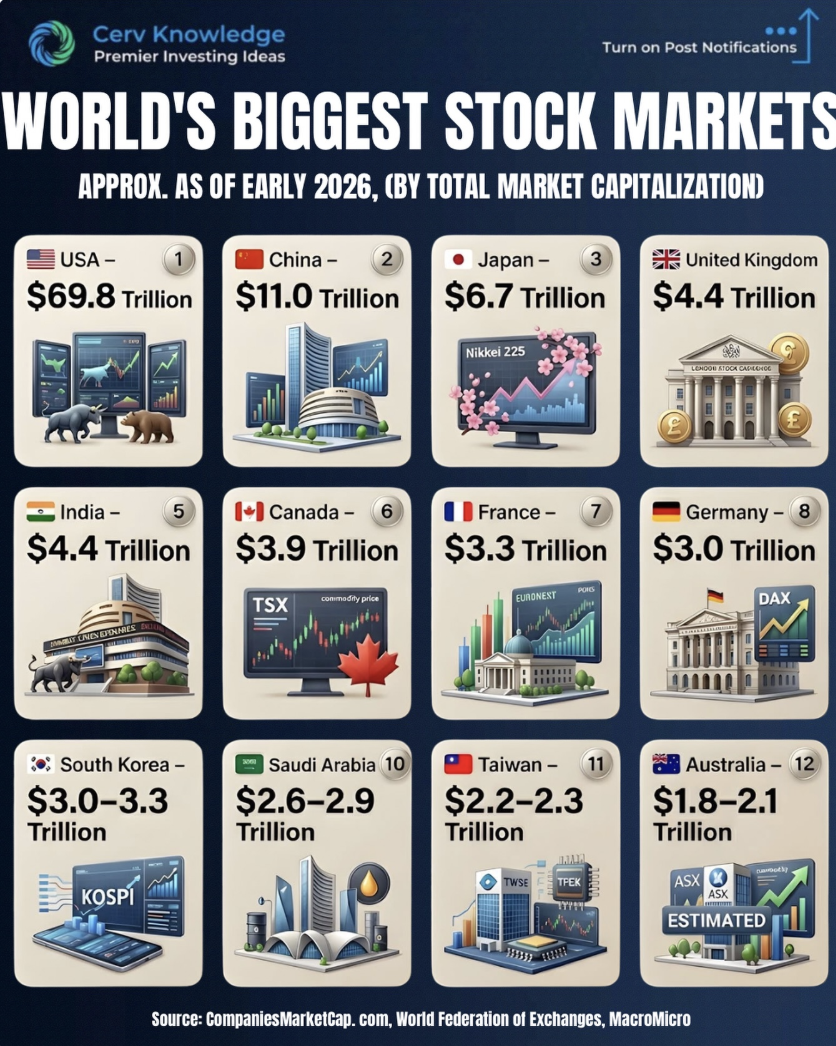
Look at this 2026 market map and your jaw should drop: the US stock market sits at $69.8T, while China trails at just $11T. That’s not a gap, that’s a canyon. This single visual rewrites a lot of lazy “US vs China” investing narratives and shows where global equity power really lives right now.
Reading the 2026 Market Map
The image ranks the world’s biggest stock markets by total market cap. The US is an outlier at $69.8T, followed distantly by China ($11T) and Japan ($6.7T). Then comes a tight middle pack: the UK and India at $4.4T, Canada at $3.9T, France at $3.3T, Germany and South Korea around $3T, Saudi Arabia just under $3T, Taiwan ~$2.3T, and Australia near $2T. In other words, the US is the market, and everyone else is playing in its shadow.
Why the US Dominates While China Lags
- The US isn’t just first; it’s over 6x larger than China and bigger than the next 11 markets combined.
- China holds a clear #2 slot, but the $58.8T gap screams capital flight, regulation risk, and weaker global participation.
- India quietly ties the UK at $4.4T, signalling capital rotating toward more open, growth-oriented markets.
- The cluster of mid-sized markets (Japan through Australia) shows diversification options, but none rival US liquidity or depth.
How Investors Can Use This Map
Vanguard structures many of its global equity funds with a heavy US tilt because the 2026 market map shows the US at $69.8T, dwarfing every other exchange.
BlackRock increasingly markets India and broader Asia ex-China ETFs as the 2026 rankings highlight India at $4.4T while China’s growth has stalled.
Creative Variations
Analyzed by Swipebot
Loading analysis...