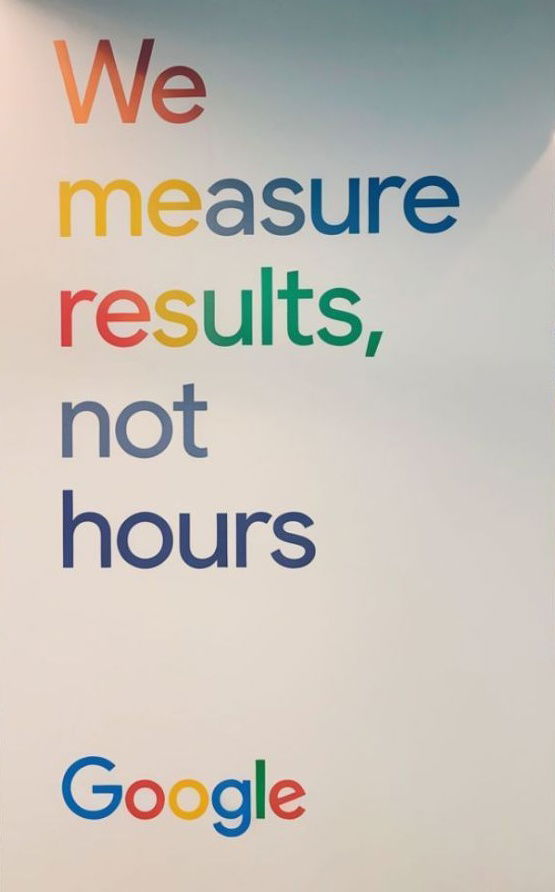
Measure Results, Not Hours

Simple wall. Huge message. Google’s “We measure results, not hours” hits harder than any management book. It’s a masterclass in how great leaders think about work and outcomes.
Why this works
- Focuses on output over input – the essence of high performance.
- Builds trust instead of micromanagement.
- Creates clarity through measurable goals, not timecards.
- Inspires ownership – people care more when trusted.
Real‑world proof
- Atlassian’s “ShipIt Days” boost innovation by freeing teams from fixed hours.
- Basecamp’s 4‑day week improved morale and productivity.
- Microsoft Japan’s experiment cut workdays by 20% and raised productivity 40%.
- GitHub’s remote‑first setup measures commits, not clock‑ins.
The takeaway: impact beats attendance. Every time.
Analyzed by Swipebot
Element Detection
This is how AI such as ChatGPT and Gemini see this image.

Text Statistics & Scores
An elementary to middle school score is best since it’s simple to understand.
10th-12th grade level
213
Total Words
12
Total Sentences
18.0
Words / sentence
67
Flesch Score
Copywriting Frameworks
Analyze the frameworks of the text
The copy identifies a core Problem (managers obsess over hours), intensifies the discomfort (Agitation) by calling it a trust issue and contrasting bad vs. great managers, then offers a multi-step Solution (five numbered actions).
- Problem: “Bad managers focus on time.”
- Agitation: “If you don’t trust your team, the issue isn’t with them, it’s with you.”
- Solution intro: “Here’s how to start measuring what really matters:” followed by steps 1️⃣-5️⃣
The text paints the ‘before’ state of clock-watching management, the ‘after’ state modeled by Google, and then bridges the gap with actionable steps.
- Before: “Bad managers focus on time.”
- After: “Google gets it. They measure results, not attendance… They prioritise impact over hours worked.”
- Bridge: “Here’s how to start measuring what really matters:” plus the five-step plan
Color Palette
These are the colors pulled from the image.