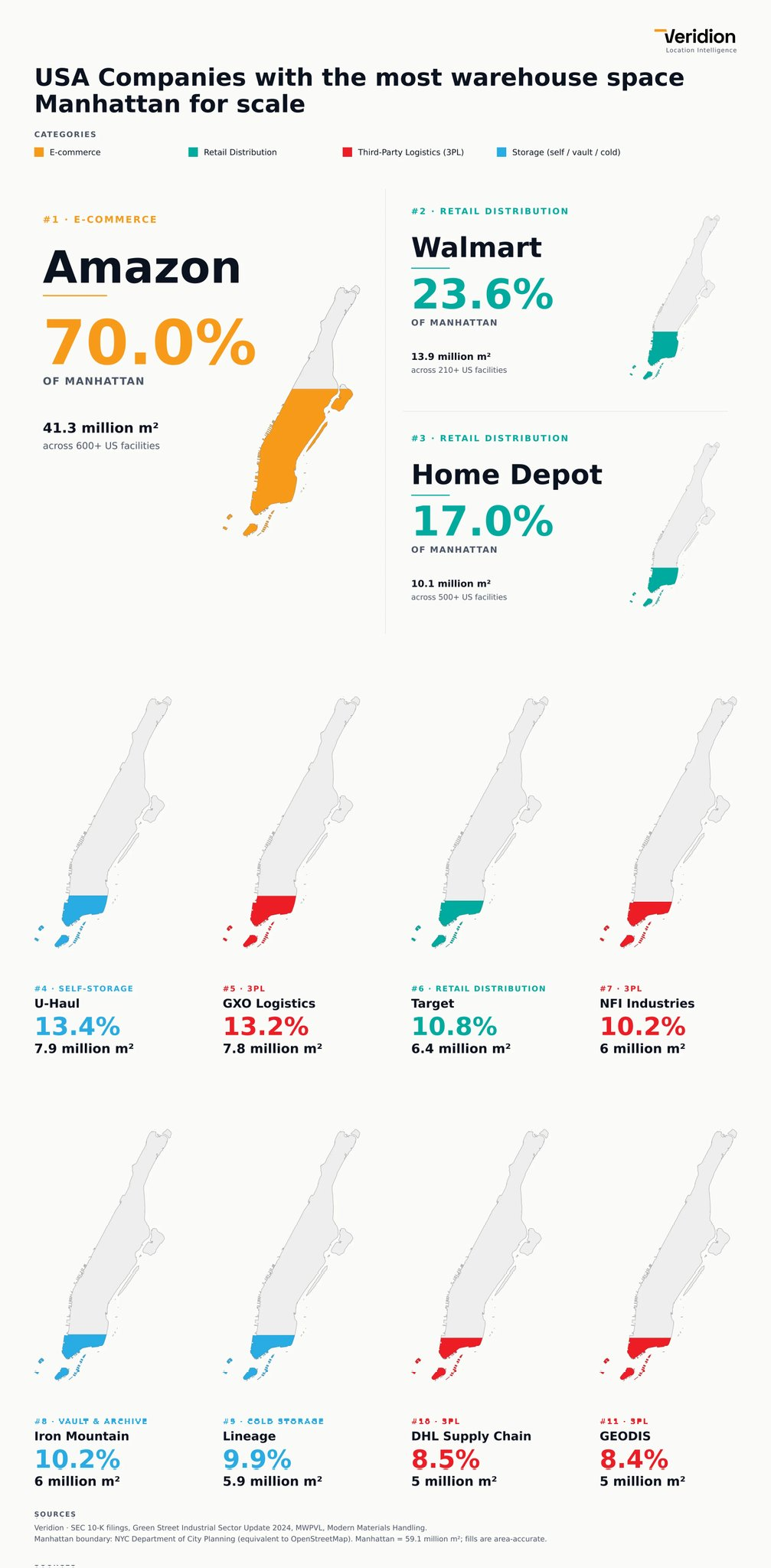
This chart doesn’t talk about revenue, ad spend, or website traffic. It shows raw land dominance. When you resize the warehouse footprints of America’s biggest logistics players to match Manhattan, Amazon alone fills 70% of the island. Everyone else is just fighting over the leftovers. Let’s break down what that means for competitors, customers, and your own business strategy.
How To Steal This Visual Strategy
Don’t just publish big numbers; wrap them around something people know. Could your SaaS uptime be “like keeping Netflix running for the entire city of Chicago for a year”? Could your production volume “cover 10 football fields every day”? The Manhattan warehouse chart works because it converts abstract scale into a street-level picture your brain can’t ignore.
What the Manhattan Map Really Shows
- Amazon’s 41.3 million m² of US warehouse space visually swallows most of Manhattan, turning “Prime” into a literal land grab.
- The next two contenders, Walmart at 23.6% and Home Depot at 17.0%, together still don’t match Amazon’s footprint.
- Specialists like U-Haul, GXO, Target, and DHL each own only Manhattan-sized slivers, which the map makes look like tiny island tips.
- The image reframes “warehouse space” from a boring metric into a shocking visual story about who actually controls the last mile.
- For marketers, this is a reminder: if your advantage is huge, don’t say it—show it with a scale your audience instantly understands.
How Companies Turn Scale Into Story
Veridion uses the Manhattan-sized map to turn dry industrial square meters into a dramatic, easy-to-grasp dominance story.
Creative Variations
Analyzed by Swipebot
Loading analysis...