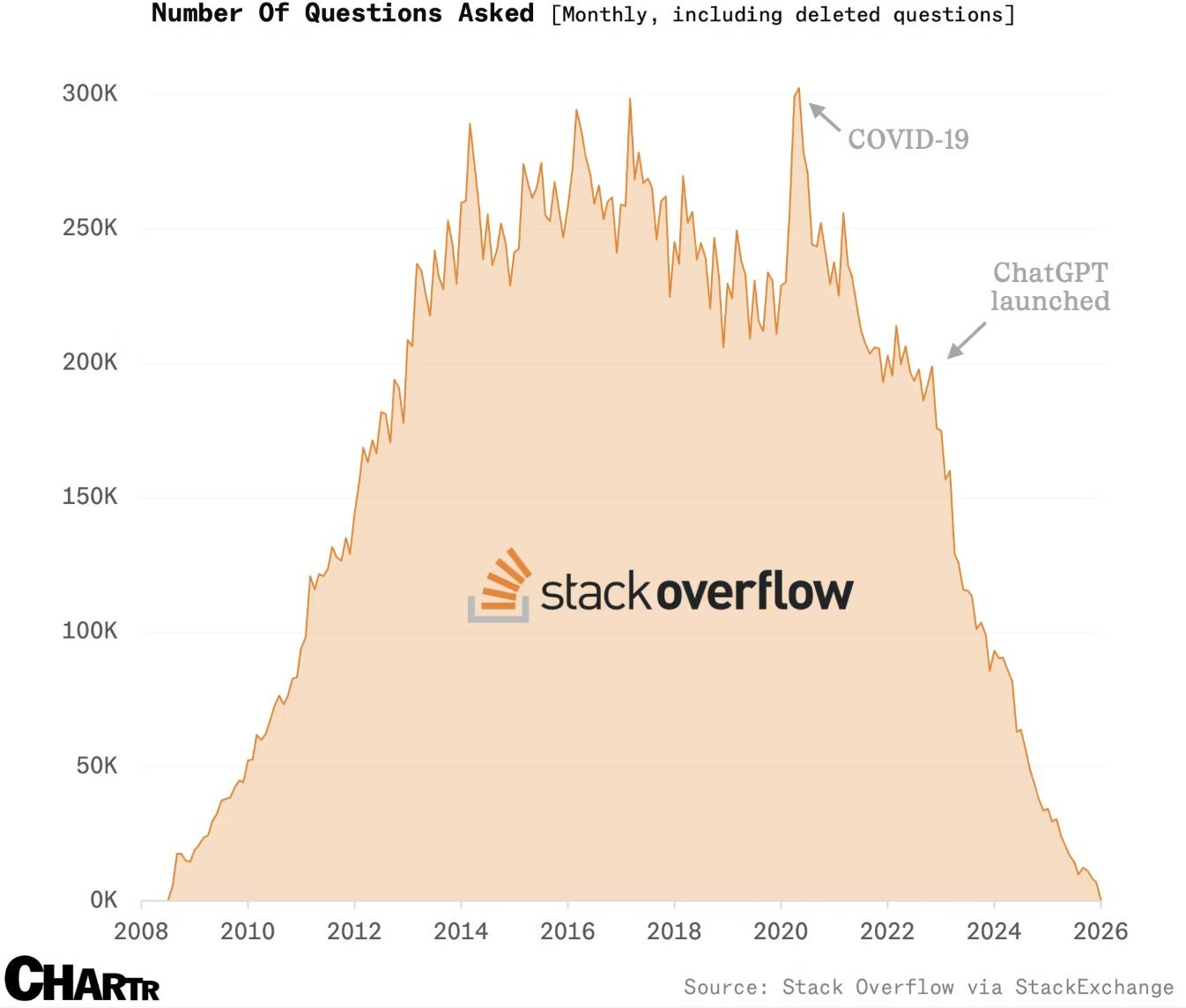
That Stack Overflow chart looks like a startup’s life story: long climb up, flat-ish peak, then a ski-slope crash right after ChatGPT shows up. Questions didn’t just decline… they fell off a cliff. If AI can nuke a beloved Q&A giant that fast, every marketer should be paying attention.
Reading the Chart Like a Marketer
From 2008 to around 2020, Stack Overflow questions explode to 300k+ per month. COVID spikes usage, then things drift down a bit. But the real moment is the “ChatGPT launched” arrow: after that, the graph doesn’t slope, it dives. Users didn’t slowly churn; they instantly switched to something that felt faster, easier, and more private than posting in public.
Marketing Takeaways From That Cliff-Dive
- You’re not competing with your category; you’re competing with “better experience” (AI, automation, self-serve).
- If your value is answers, tools, or templates, assume AI becomes the default and build on top of it, not against it.
- Public, slow, and search-based lost to private, instant, and conversational—audit your product for those three upgrades.
- The longer your graph looks like Stack Overflow’s 2010–2020 climb, the more vulnerable you are to a single disruptive launch.
- Moats now come from community, brand, and proprietary data, not just being the biggest library of information.
How Others Are Reacting Instead of Getting Replaced
Stack Overflow is testing an AI-powered conversational assistant trained on its Q&A archive instead of only relying on the old posting model.
GitHub wrapped AI directly into developer workflows with GitHub Copilot so the "ask a question" moment happens inside the editor, not on a separate site.
Analyzed by Swipebot
Loading analysis...