Don't Build — Find Distribution First
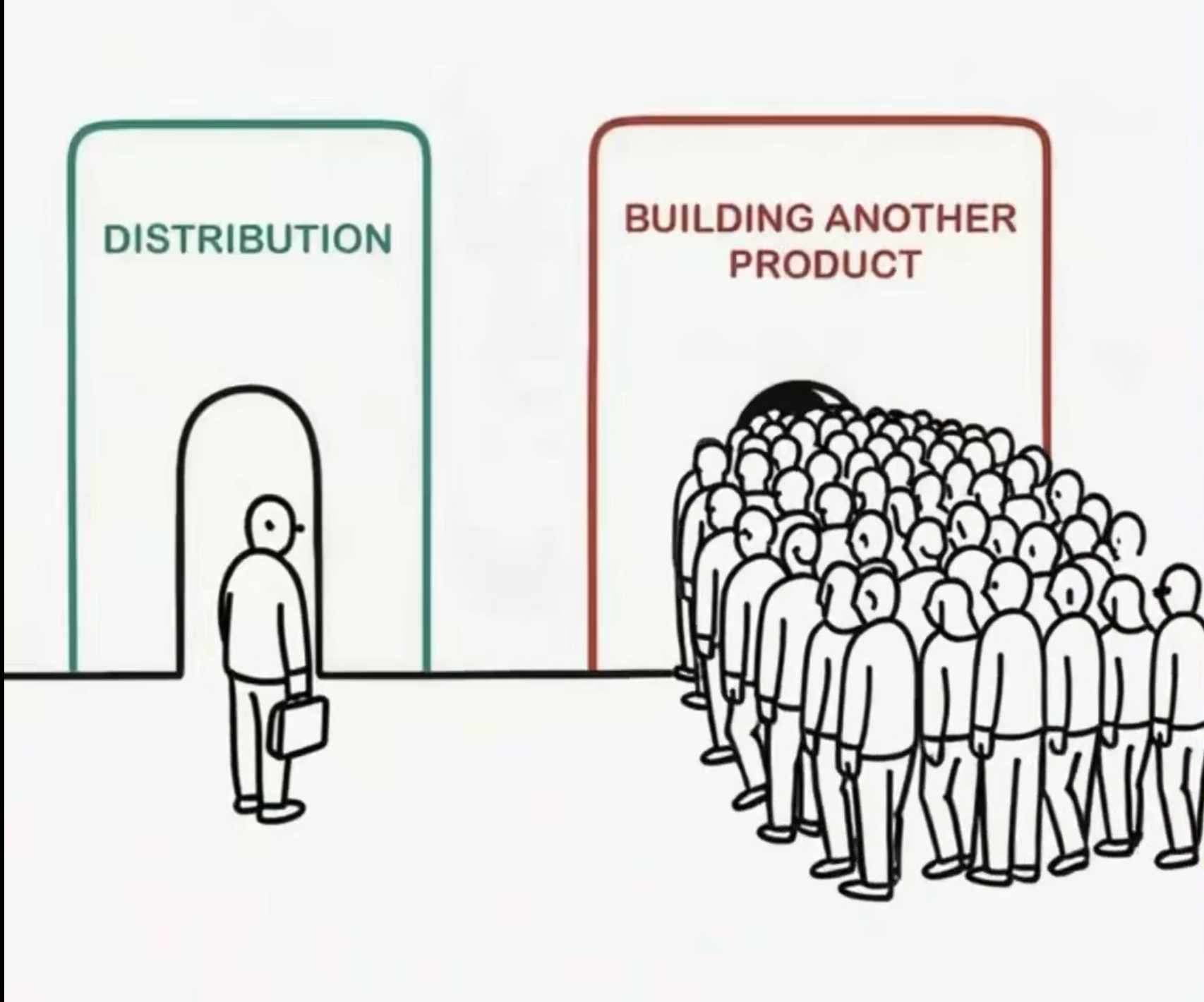
Look at the image: one lonely founder stands in front of a wide-open door labeled “DISTRIBUTION,” while a massive crowd shoves into a door labeled “BUILDING ANOTHER PRODUCT.” That picture is the entire startup graveyard in one frame. Most people sprint to build; almost nobody races to secure eyeballs, traffic, and buyers. This post is a reminder to walk through the empty door first.
What the Sketch Is Screaming at You
The crowd at the “Building Another Product” door represents every founder obsessing over features, frameworks, and fancy tech. The single person at the “Distribution” door is the weirdo who realizes that if you already control attention, you can bolt on almost any product and make money. The drawing flips the usual script: your real startup is the audience and channels you own, not the app you’re itching to code.
How to Walk Through the Right Door
Before you touch a line of code, answer: whose audience can I borrow or buy? Make a list of newsletters, YouTube channels, communities, agencies, and marketplaces that already have your ideal users. Pitch them first. Build an email list landing page, a simple PDF, or a waitlist and prove you can get 100–1,000 people to raise their hand. Only then earn the right to build. The goal is not “launch a product,” it’s “own a pipeline of people who trust me.”
The Psychology Behind Choosing the Wrong Door
- Building feels productive and safe; pitching, selling, and negotiating distribution feels scary and rejection-heavy.
- We fantasize that “if I build something great, people will just find it,” which lets us delay learning marketing.
- Code is controllable; distribution depends on other humans, platforms, and messy relationships.
- Social proof pushes us into the crowded door: everyone talks about product launches, almost nobody brags about quietly locking down a killer email list or partnership.
Real-World Proof That Distribution Wins
Morning Brew built a huge email newsletter audience first, then layered on ads, products, and spin-offs to monetize the distribution they already owned.

Shopify created an app store and partner ecosystem so that new tools plug into existing merchants instead of hunting for customers from scratch.
Product Hunt turned its daily audience of early adopters into a launchpad distribution channel that startups beg to access.