SpaceX Owns Orbit: The Investment Play
Published on
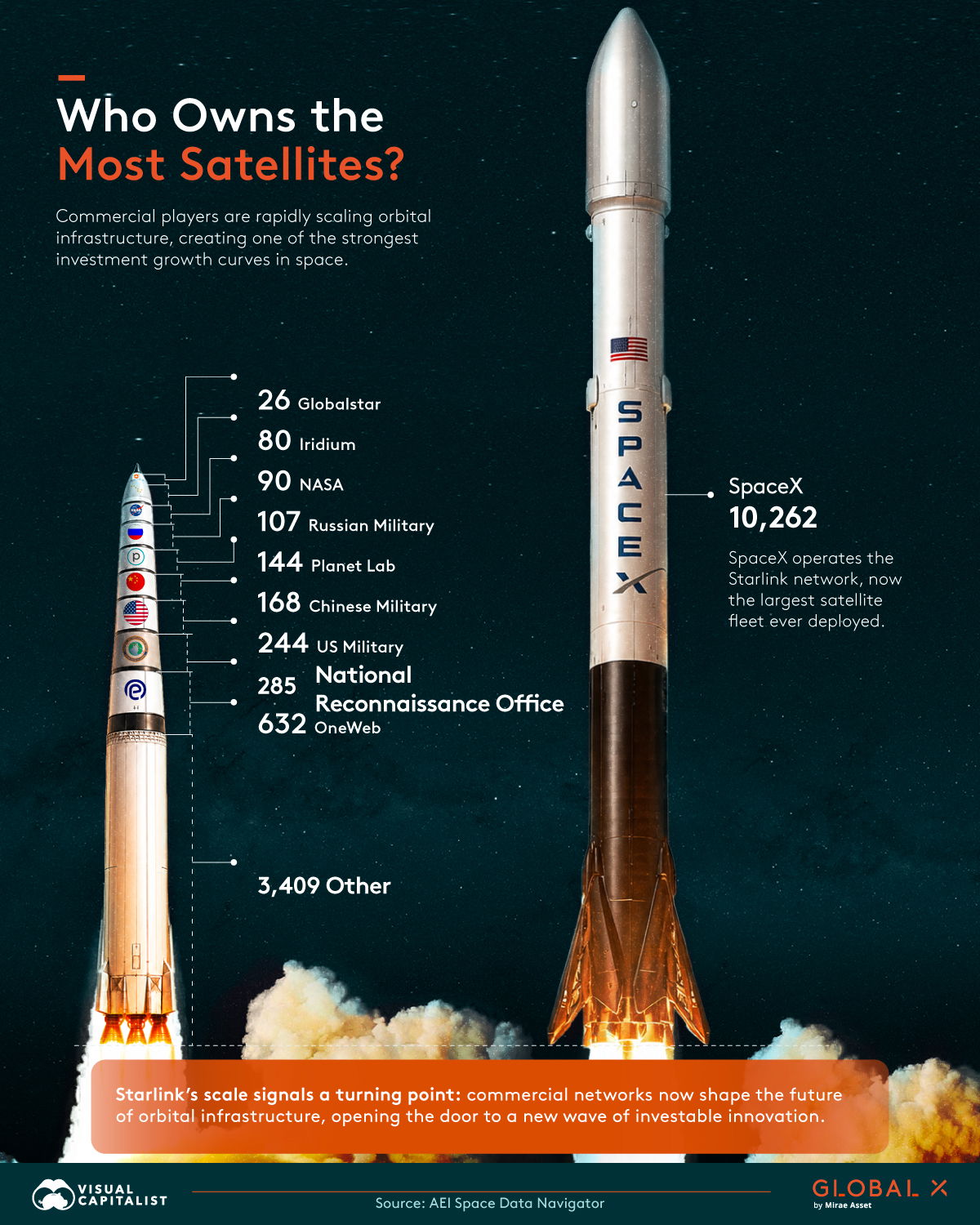
Look at this chart and forget every polite thing you’ve ever heard about “competition” in space. SpaceX isn’t competing for orbit anymore—it owns the neighborhood. When one company has more metal in the sky than entire governments, you’re not just looking at rockets, you’re looking at a new kind of telecom, defense, and data monopoly being built in real time.
The Chart That Should Make Investors Sit Up
The graphic shows a simple but brutal scoreboard: SpaceX with 10,262 satellites, then a steep drop-off to everyone else. OneWeb has 632, the US military 244, China’s military 168, NASA just 90. A fat “3,409 Other” bucket proves how fragmented the rest of the field is. Visually, it’s a skyscraper of SpaceX towering over a village of also-rans—exactly what compounding looks like when you turn it into rocket exhaust.
Why This Dominance Matters for Your Portfolio
- Network effects: every new Starlink satellite makes the entire constellation more valuable, improving coverage, latency, and reliability.
- Switching costs: once enterprises, governments, and remote regions plug into Starlink, ripping it out becomes painful and pricey.
- Regulatory moat: orbital slots and spectrum are finite; early, aggressive deployment quietly locks competitors out.
- Multi-industry upside: the same fleet can power residential internet, defense communications, aviation, maritime, and IoT—all from one orbital platform.
How Capital Is Already Playing the SpaceX Orbit Story
Global X positions its space-themed ETFs around the thesis that commercial satellite networks like SpaceX’s Starlink are now the core growth engine of orbital infrastructure.
Visual Capitalist uses this satellite-count graphic to frame SpaceX as the central infrastructure layer in the emerging commercial space economy.
Creative Variations
Analyzed by Swipebot
Loading analysis...