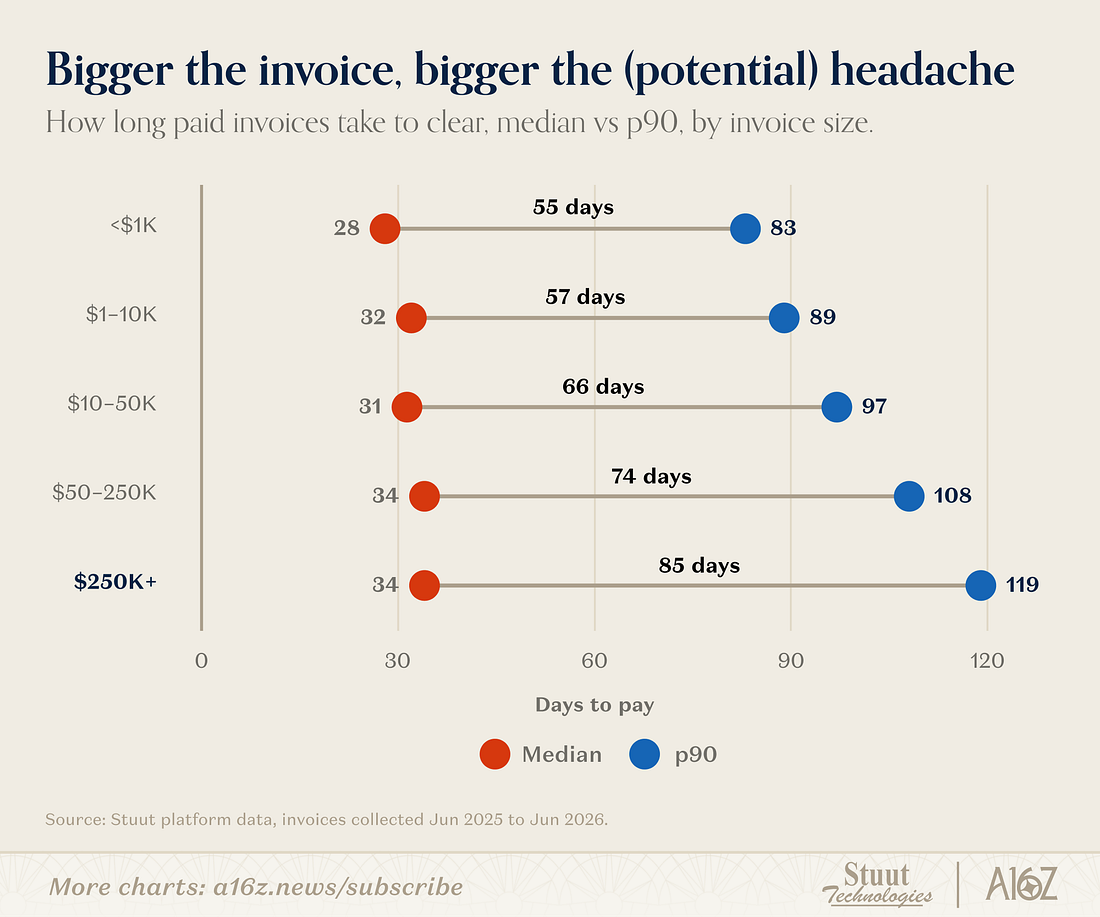
Everyone loves landing a big client…right up until the invoice sits in limbo for three months. This chart shows how payment times stretch as invoices get fatter, and the numbers are ugly. If cash is your company’s oxygen, large invoices are like holding your breath underwater.
What the chart actually shows
The graphic breaks invoices into five size buckets and tracks how many days it takes to get paid. The red dots are median days to pay, and the blue dots are the painful p90 outliers. As invoice size climbs from under $1K to $250K+, the blue dots march steadily right, ending at 119 days for the biggest invoices.
The psychology behind slow giant invoices
- Small invoices (<$1K) clear fast because they fit inside normal approval limits and feel low‑risk.
- $10–50K invoices jump to a 66‑day median as more managers, legal, and procurement pile on.
- $250K+ invoices barely move the median (34 days) but explode the worst‑case to 119 days, signaling that one snag can freeze six figures of cash.
- Your real risk lives in the blue p90 dots, not the pretty median; that tail is what wrecks payroll and growth plans.
How smart companies de‑weaponize big invoices
Stripe breaks large contracts into milestone-based invoices so each approval is smaller and faster.

Shopify encourages merchants to use automatic billing and saved payment methods to shrink both median and p90 payment delays.
HubSpot offers discounts for annual prepayment to avoid the 100‑day payment purgatory of repeated large invoices.
Creative Variations
Analyzed by Swipebot
Loading analysis...
.png?width=3840&quality=80)