How Oura Makes Money Graph
Published on
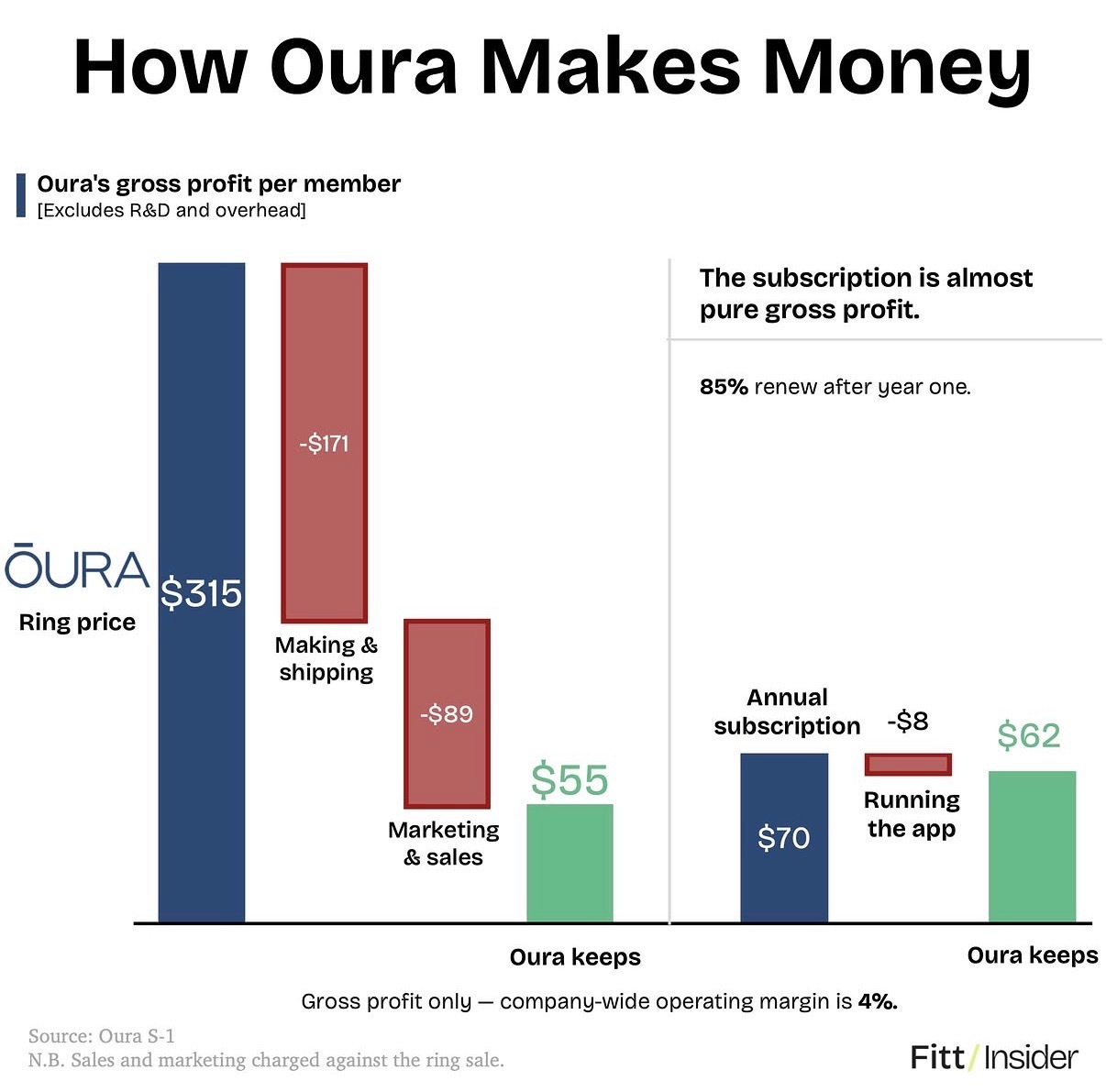
Look at Oura’s own numbers and you’ll see the ring is just the shiny bait. The real money printer is that little subscription charge quietly hitting your card every year. This chart from Oura’s S-1 lays it out in brutal, beautiful detail. Once you see the profit split, you’ll never look at hardware the same way again.
The Ring Is a Breakeven Gadget
Oura sells the ring for $315, but the graphic shows $171 to make and ship it, plus $89 on marketing and sales. After all that, Oura only keeps $55 in gross profit per member from the hardware. That’s decent, but for a physical product with real-world costs and headaches, it’s not a champagne-popping margin.
The Subscription Is Basically Pure Profit
Now slide your eyes to the right side of the image. Oura charges $70 per year for the subscription, and only $8 goes to “running the app.” That leaves $62 in gross profit from software alone. Same customer, no factory, no shipping, no big marketing push every time. And 85% of members renew after year one, turning each ring buyer into an annual cash-flow asset.
The Psychology Behind Oura’s Cash Machine
- Front-end hardware creates commitment: once someone pays $315 for a ring, canceling a $70 subscription feels like wasting the device.
- Subscription is priced as a no-brainer: less than many people’s monthly coffee habit, but worth it to “unlock” their sleep and recovery data.
- High renewal rate (85%) compounds: each extra year turns that original $55 hardware profit into hundreds in software margin.
- Costs stay tiny while revenue stacks: $8 per member to run the app barely moves even as more people pile onto the platform.
Who Else Plays the Oura Game?
Peloton sells connected bikes close to hardware margins so Peloton can rake in recurring revenue from its all-access membership every month.
WHOOP gives away or heavily discounts bands so WHOOP can monetize long-term via its data-driven training subscription.
Creative Variations
Analyzed by Swipebot
Loading analysis...