Use Apple’s 'Crazy Ones' Copy Formula
Updated on
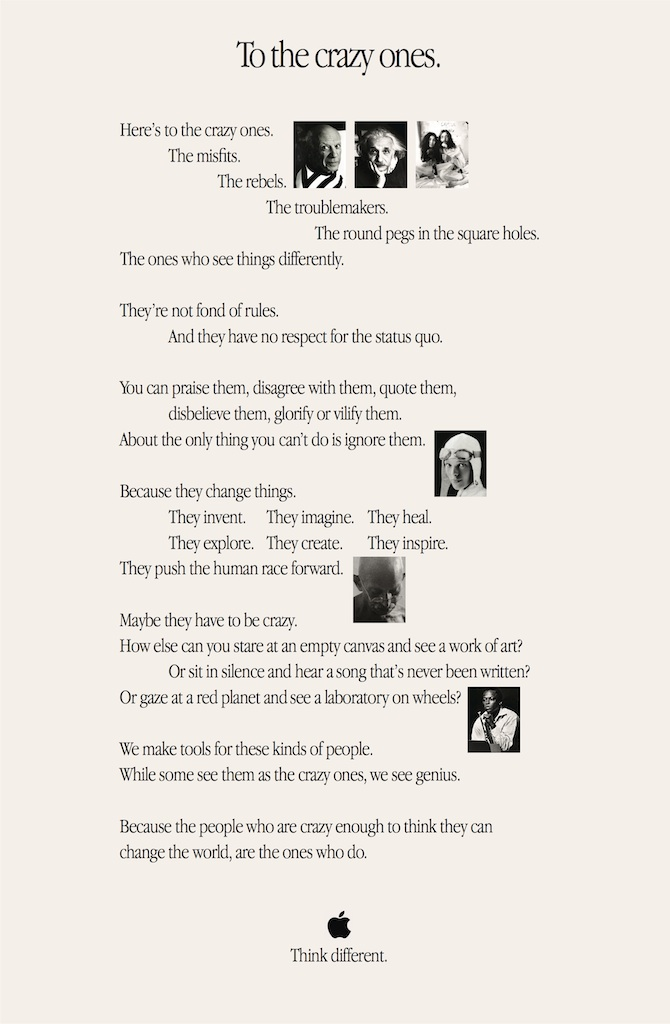
Apple’s legendary “To the crazy ones” ad is basically a plug‑and‑play formula for writing copy that gives your readers goosebumps. You don’t need a billion‑dollar brand or a Hollywood director to use it. All you need is a clear hero (your customer), a bold belief, and the guts to say it out loud. Here’s how to steal the structure and use it in your own emails, sales pages, and ads.
Turn it into a swipeable template
Here’s a fill‑in‑the‑blanks version you can drop into your next sales page: “Here’s to the [specific group]. The [identity 1]. The [identity 2]. The [identity 3]. The ones who [see/approach] [topic] differently. They’re not fond of [enemy]. And they have no respect for [old way]. You can [action], [action], or [action] them. About the only thing you can’t do is ignore them. Because they [impact 1]. They [impact 2]. They [impact 3]. They push [field] forward. We make [product] for these kinds of people. While some see them as [insult], we see [compliment]. Because the people who are [bold belief] enough to [desired outcome], are the ones who do.”
Break down the 'Crazy Ones' copy formula
- OPEN WITH A TOAST: “Here’s to the crazy ones…” instantly tells you who this is for and flatters them.
- LABEL YOUR TRIBE: Stack short, rhythmic nouns (“The misfits. The rebels. The troublemakers.”) to make readers say, “That’s me.”
- DRAW THE LINE: Contrast them with the status quo so your audience feels proudly different.
- SHOW THEIR IMPACT: Use crisp verbs (“They invent. They imagine. They heal.”) to paint how they change the world.
- REVEAL YOUR ROLE: Shift to your brand last (“We make tools for these kinds of people”) so the product becomes an inevitable sidekick.
- END WITH A MANTRA: Close on one sticky belief (“Think different.”) your audience can repeat to themselves.
Modern brands using their own 'Crazy Ones' angle
Mailchimp celebrates small, scrappy business owners as the quirky underdogs who power the modern economy instead of just talking about email features.

Shopify positions independent merchants as rule‑breakers building the future of retail rather than cogs inside a giant marketplace.
Creative Variations
Analyzed by Swipebot
Loading analysis...