Unicorn Founders Now Average Age 40
Published on

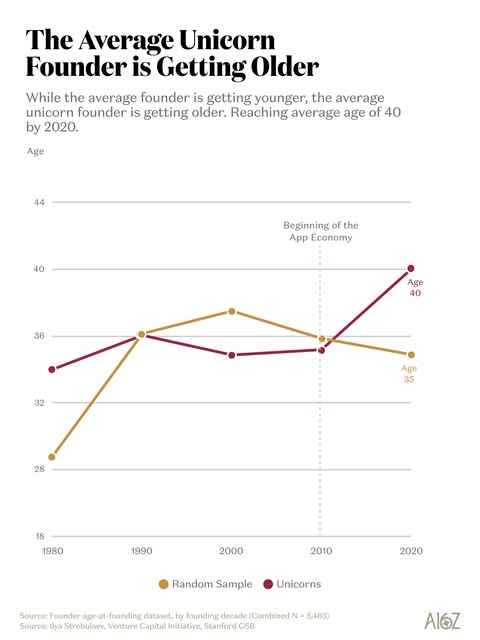
If you still think unicorn founders are hoodie-wearing 22‑year‑olds fresh out of a dorm room, this chart should rattle your brain. The a16z graphic shows that by 2020, the average unicorn founder hit age 40. Meanwhile, the “random founder” trend line actually gets younger. Translation: the biggest outcomes are increasingly coming from older, more experienced operators, not first‑time kids chasing TechCrunch headlines.
What the chart actually shows
The maroon line (unicorn founders) climbs steadily from the mid‑30s in the 1980s to about 40 by 2020. The gold line (random founders) shoots up from the late 20s to mid‑30s around the start of the app economy, then flattens and slightly dips, ending near 35. So while the total pool of founders skews younger, the ones building $1B+ companies skew older and keep aging up over time.
The psychology behind older unicorn founders
- More cycles = better pattern recognition, so 40‑year‑olds avoid rookie mistakes that kill billion‑dollar upside.
- Later‑stage founders usually have industry connections, giving them unfair distribution and hiring advantages.
- Capital has gotten more abundant, so investors now bet on repeat operators with proof, not just youthful potential.
- Unicorns typically attack gnarlier, regulated markets where domain expertise and political savvy matter more than raw code speed.
How to use this insight in your own story
Startup accelerators can reposition their messaging to say that their best bets are often second‑time or mid‑career founders, not just recent grads chasing their first idea.
Venture firms can redesign their pitch decks to LPs emphasizing that their deal flow intentionally targets experienced operators in their late 30s and 40s because this is where unicorn outcomes concentrate.
Corporate innovation teams can use this data to justify spinning out seasoned insiders as founders, instead of only sponsoring hackathons for junior employees.
Analyzed by Swipebot
Loading analysis...
.png?width=3840&quality=80)