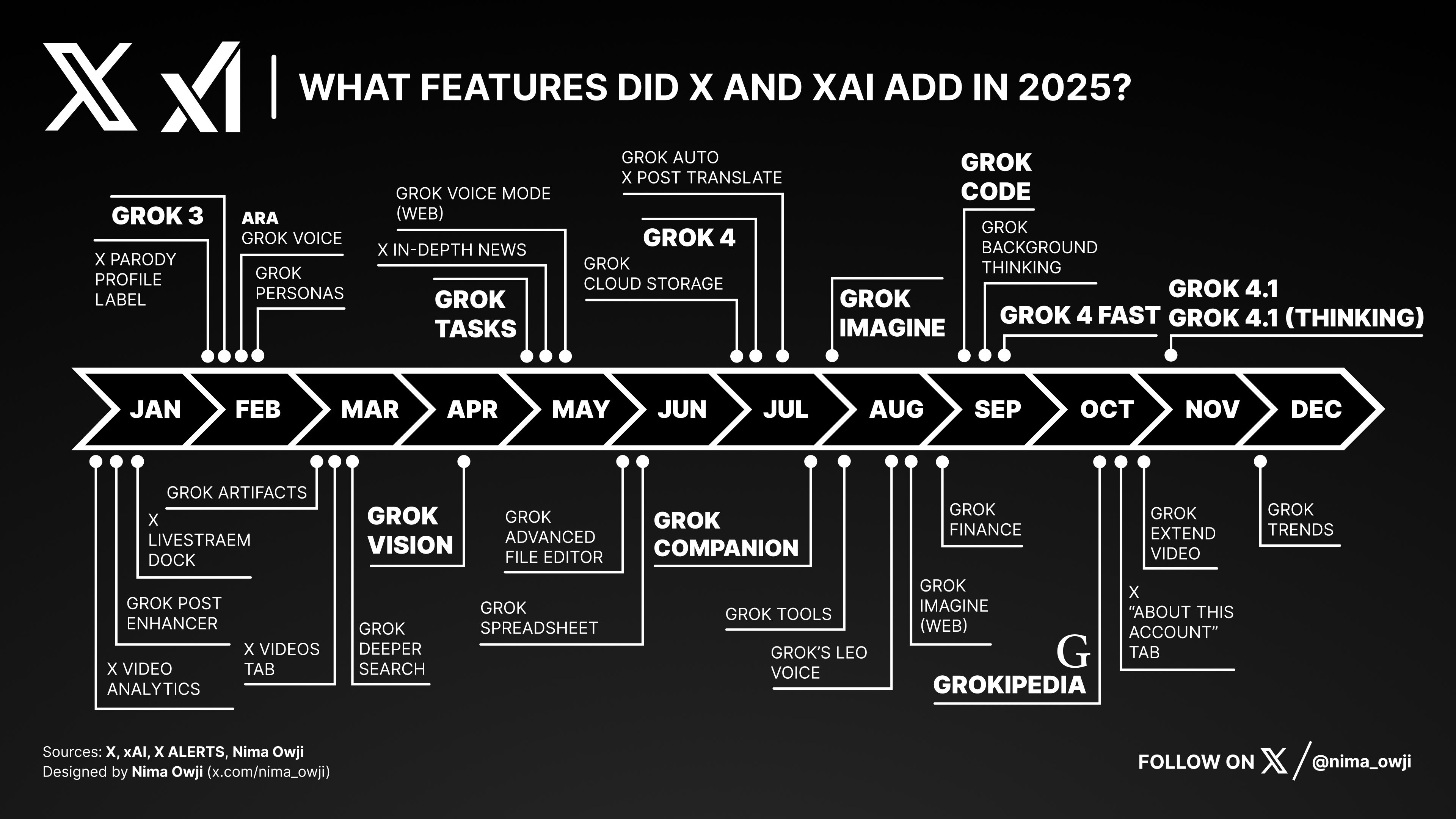
This roadmap graphic lays out a full year of Grok upgrades for X and xAI in 2025, month by month. It’s basically a product launch calendar on a single slide: Grok 3 to 4.1, new voice modes, vision, tasks, finance, and even a Wikipedia-style Grokipedia. Use it as a planning template for your own AI rollout: stack big flagship releases on top, support tools on the bottom, and make every month feel like an event.
Reading the Roadmap at a Glance
The image splits 2025 into twelve bold arrows from January to December. Above the arrows you get the headline Grok releases: Grok 3 in January, Grok Tasks in April, Grok 4 in June, Grok Imagine in August, Grok Code and Grok 4 Fast in October, and Grok 4.1 in November. Below the arrows are supporting launches: livestream tools, analytics, Grok Vision, spreadsheets, Grok Companion, Grokipedia, finance, trends, and more. It’s a stacked release ladder where each month adds another AI capability to the X ecosystem.
The Psychology Behind This Rollout
- Each month has at least one named feature, so users never feel like the product is standing still.
- Big branded drops like “Grok Companion” and “Grokipedia” act as anchor events, while smaller tools quietly increase daily utility.
- Feature clusters (voice in Q1, productivity in Q2, creativity in Q3, dev power in Q4) make the year feel like a planned story instead of random launches.
- Labeling versions clearly (Grok 3 → Grok 4 → Grok 4.1) reassures power users that the core model is evolving along with the apps.
- Tying everything visually to one horizontal timeline turns a messy changelog into a simple, shareable graphic roadmap.
How You Can Steal This Structure
SaaS companies can copy this X and xAI roadmap format by plotting one flagship product milestone per quarter with 2–3 supporting feature releases in each month.

AI startups can mirror the Grok rollout by naming each model upgrade clearly, then surrounding it with practical tools like editors, analytics, and companion apps.
Creative Variations
Analyzed by Swipebot
Loading analysis...