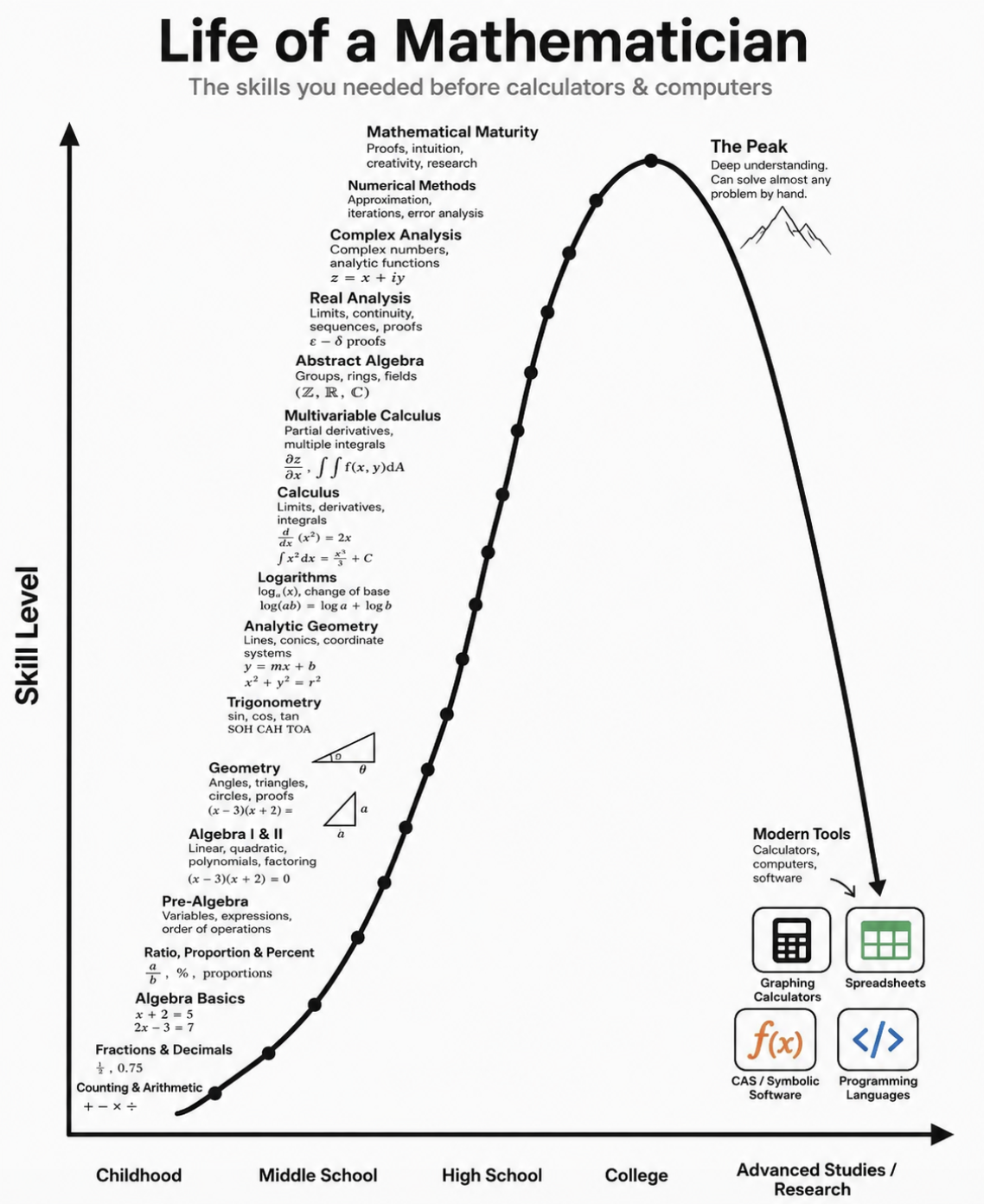
This chart shows the brutal, beautiful climb of a pre-computer mathematician. No apps, no WolframAlpha, no spreadsheet safety net. Just you, a pencil, and a stack of concepts that build from counting marbles to wrestling with proofs. Use this roadmap to see exactly which rungs of the ladder you’re missing—and how people used to reach “can-solve-almost-anything-by-hand” level.
The Psychology Behind It
Before calculators, every bump on this curve had to live in your head. That forced depth: you didn’t just know the derivative rule, you knew why it worked because you had to derive it yourself. The image also shows a sharp drop after the peak—modern tools take over the grunt work. That’s not bad; it just means the new game is different: use computers for computation, but still walk this old-school ladder if you want real, transferable problem-solving power.
Reading the Roadmap from Bottom to Peak
- Childhood: counting, fractions, and basic algebra are the foundation stones, not optional side quests.
- Middle school: ratios, geometry, and trig wire your brain for thinking in relationships, not just numbers.
- High school: algebra II, analytic geometry, logs, and calculus turn math from ‘answers’ into ‘systems.’
- College: multivariable calculus, abstract algebra, and real/complex analysis demand proof-level thinking.
- Peak: mathematical maturity means you can attack new problems with intuition, not just formulas.
How Modern Tools Plug Into the Old Ladder
Excel uses your understanding of ratios, algebra, and functions to turn a spreadsheet into a financial model instead of just a fancy table.
Wolfram Alpha lets you outsource integration and symbolic algebra, but it still rewards people who understand calculus and can ask precise questions.
Python turns mathematical maturity into code, letting you translate the same pre-computer ideas into simulations, optimization, and data science workflows.
Creative Variations
Analyzed by Swipebot
Loading analysis...