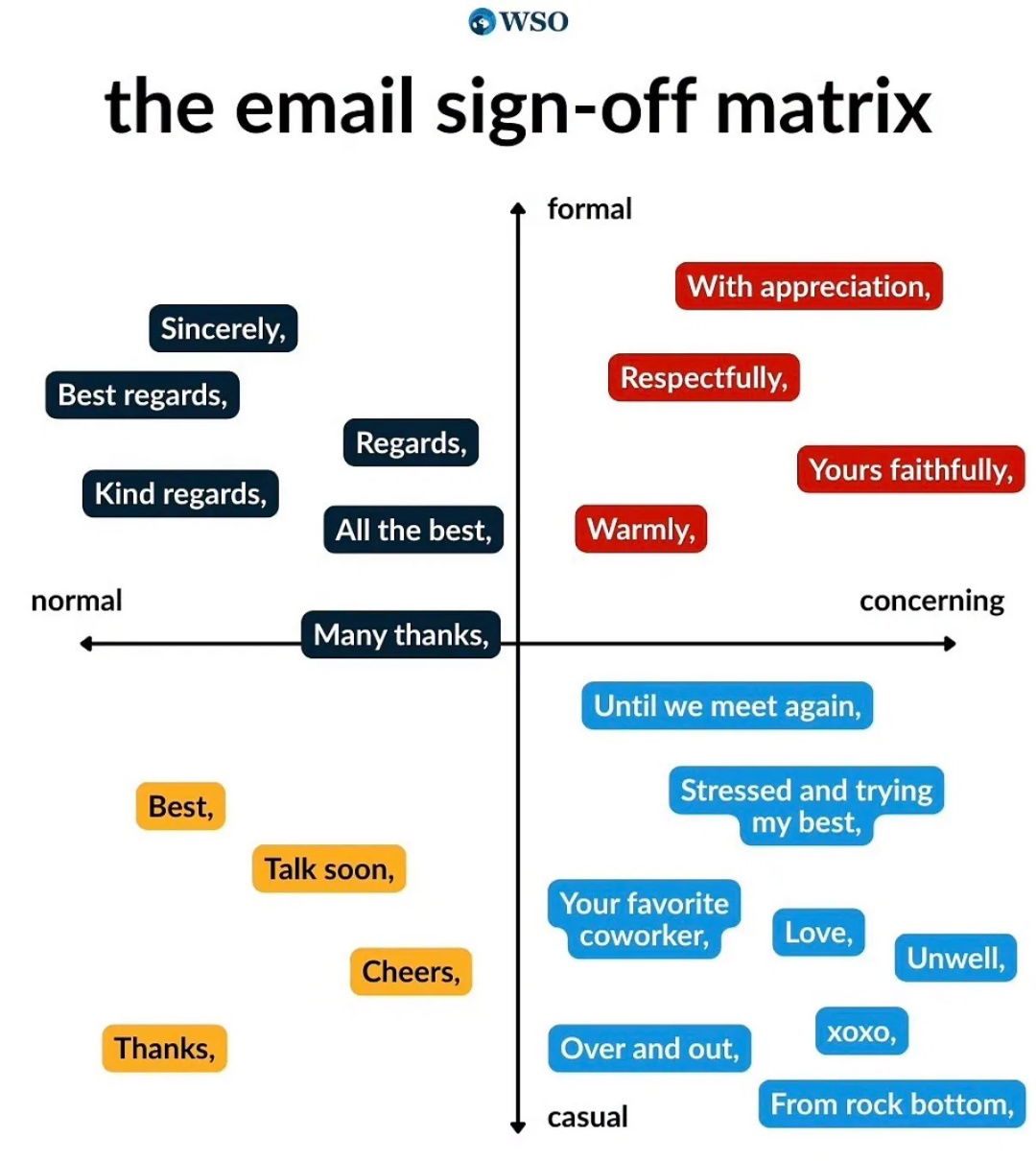
Your sign-off is the last taste of you someone gets in their inbox. This “email sign-off matrix” shows how a single word at the bottom can swing from buttoned‑up professional to “should we call HR?” Match your tone to the grid and your emails instantly feel more intentional and less weird.
Reading the Email Sign-Off Matrix
The image maps sign-offs on two axes: formal → casual (vertical) and normal → concerning (horizontal). Top-left lives the safe corporate crew: “Sincerely,” “Best regards,” “Kind regards,” “Regards,” “All the best,” and “Many thanks,” for polite, professional messages. Slide down to bottom-left for everyday casual: “Best,” “Talk soon,” “Cheers,” and “Thanks,” when you’re friendly but not oversharing.
Where It Gets Weird (In a Fun Way)
On the right side, the matrix warns you you’re entering drama territory. The formal-but-intense block has “With appreciation,” “Respectfully,” “Warmly,” and “Yours faithfully,” which feel heavy for routine office ping‑pong. Go more casual and the wheels come off: “Until we meet again,” “Stressed and trying my best,” “Your favorite coworker,” “Love,” “Unwell,” “Over and out,” “xoxo,” and “From rock bottom,” all scream more about your emotional state than the email content.
How To Match Your Sign-Off To Tone
- Use the top-left for clients, bosses, and first-time contacts (it’s boring, but it never backfires).
- Use bottom-left with coworkers you already know, quick replies, and low-stakes updates.
- Use the right side sparingly and intentionally—great for jokes with close teammates, terrible for cold emails.
- When in doubt, move one square more formal and less concerning than your instinct.
Real-World Ways To Use The Matrix
A SaaS founder emailing investors sticks to the safe zone with "Best regards," to keep the update polished but not stiff.
A creative agency project manager nudges a designer with a casual "Cheers," because the relationship is friendly and ongoing.
An internal employee newsletter intentionally signs off with a playful "Over and out," to signal this is culture content, not compliance training.
Creative Variations
Analyzed by Swipebot
Loading analysis...