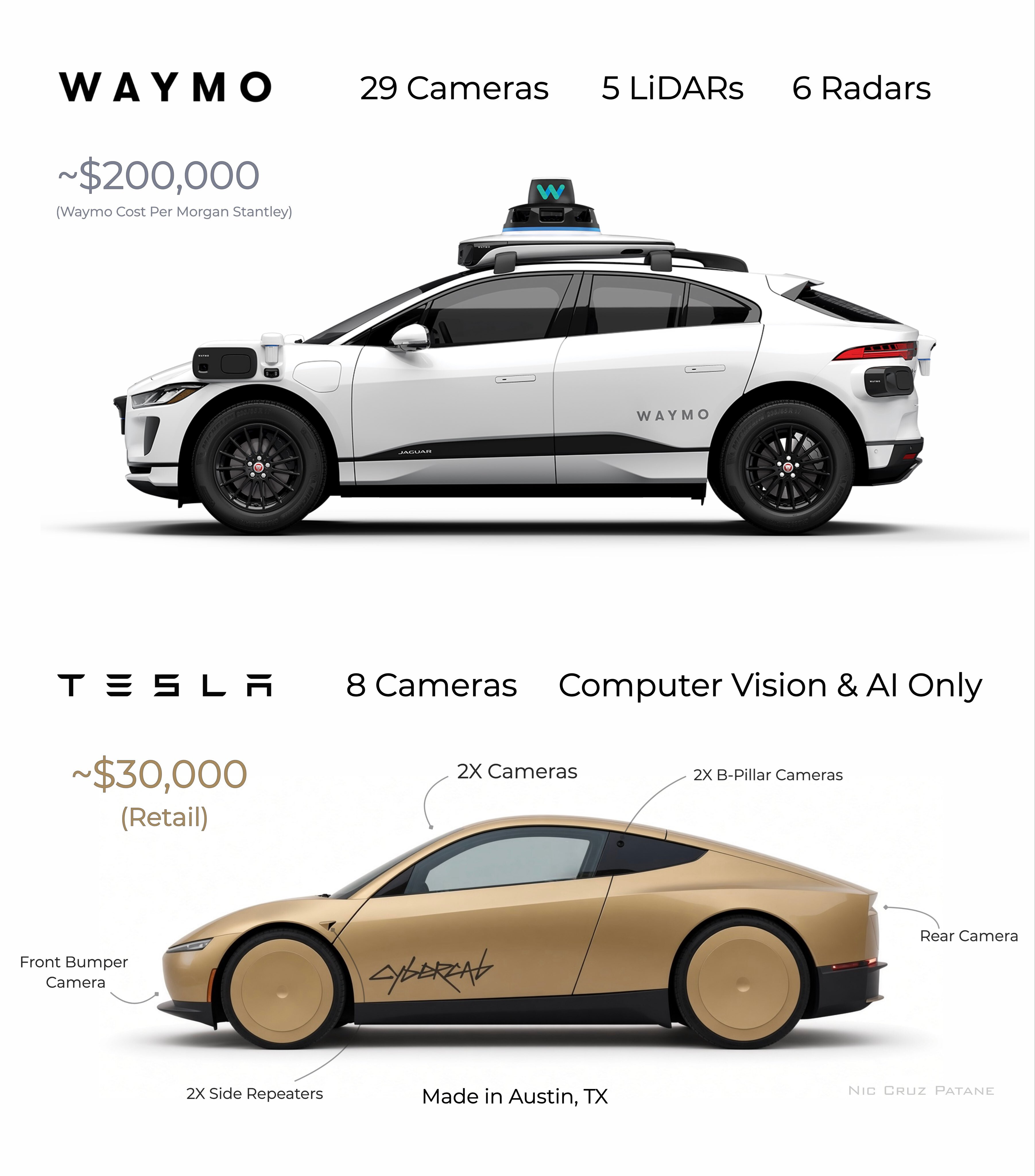
This graphic is a $200,000 staring contest between two robots on wheels. On top you’ve got Waymo’s sensor porcupine, bristling with LiDARs and radars. On the bottom sits Tesla’s smooth, camera‑only gambler. Same end goal (self‑driving), totally different bill.
The psychology behind this sensor war
Look at the silhouettes. Waymo’s stack looks like a lab instrument escaped onto a Jaguar. Visually, it says: “We’re over‑prepared. We see everything. Safety at any cost.” Tesla’s clean roofline says: “This is just a car. Get in and go.” One feels like infrastructure, the other like an iPhone. Both brands are selling the same promise—hands‑off driving—but the picture makes it obvious who wants to dominate a few cities and who wants to own every driveway.
What the image screams without saying a word
- Waymo’s car is a $200,000 science project: 29 cameras, 5 LiDARs, 6 radars bolted everywhere.
- Tesla’s concept is a $30,000 consumer product: just 8 cameras and a lot of software confidence.
- Waymo is betting on expensive, redundant hardware; Tesla is betting that cheap cameras plus AI will be “good enough.”
- The real war isn’t sensors vs sensors, it’s business model vs business model: robotaxi fleet vs mass‑market car.
How each company turns sensors into a story
Waymo uses the sensor tower, LiDAR domes, and radars in the image to visually prove that its robotaxis are over‑equipped for chaos on public roads.
Tesla uses the sleek, camera‑only Cybercab design in the image to reinforce its narrative that vision plus AI will beat expensive LiDAR in the real world.
Creative Variations
Analyzed by Swipebot
Loading analysis...