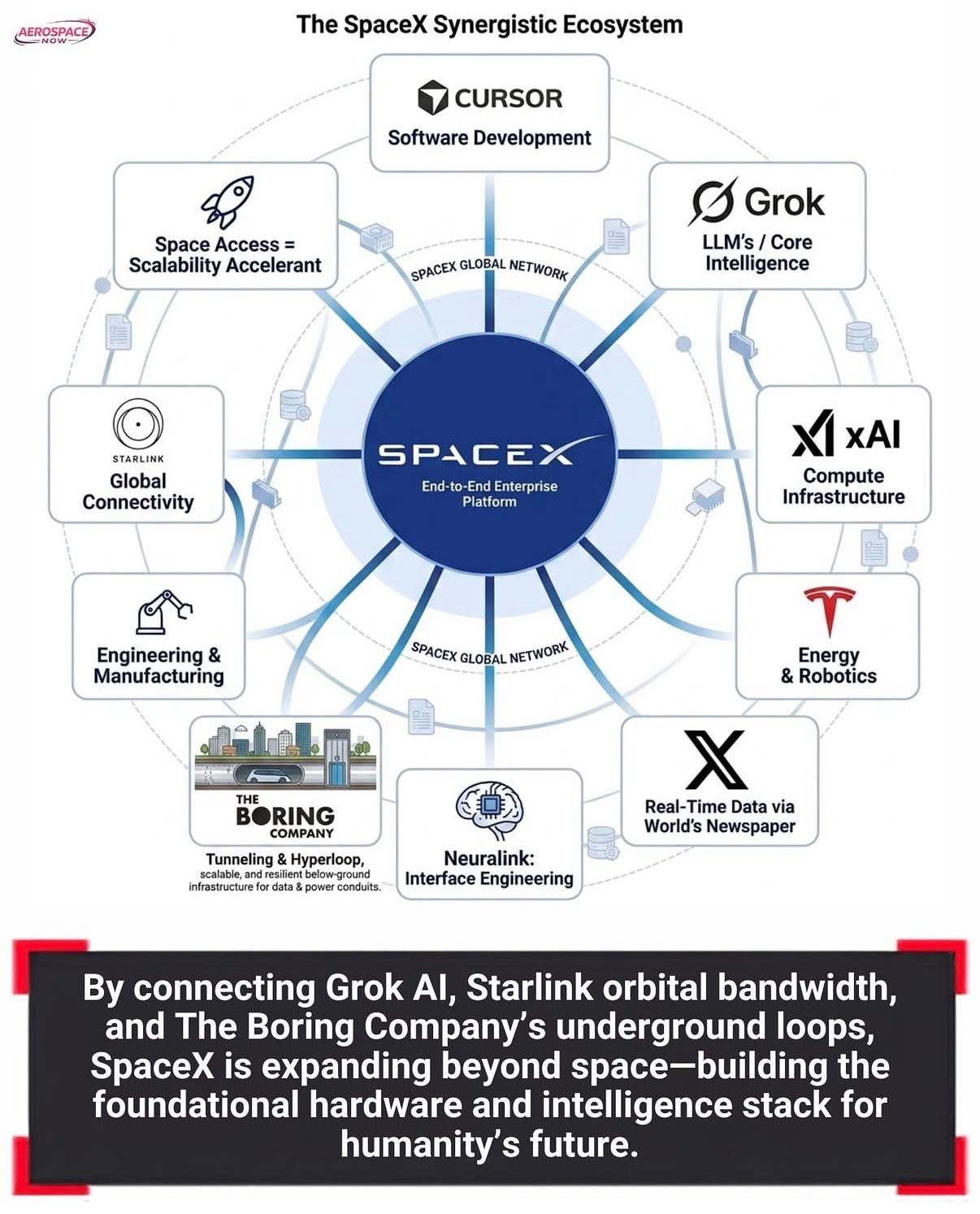
Most people still think SpaceX is just rockets and fiery landings. The diagram you’re looking at blows that idea to pieces. It shows SpaceX quietly wiring together AI, bandwidth, tunnels, robots, and brain-computer interfaces into one end-to-end enterprise platform. This isn’t a space company anymore; it’s an infrastructure monopoly in slow motion. Let’s decode how this “synergistic ecosystem” actually works.
Why This Ecosystem Is So Dangerous (In a Good Way)
Look at the image as a flywheel, not a pretty org chart. Every new tunnel, satellite, robot, or neural interface throws off more real-time data. That data feeds Grok and xAI, which makes the AI smarter. Smarter AI means faster engineering cycles, better reusable rockets, denser constellations, and cheaper launches. Cheaper launches then make it economical to deploy even more Starlink capacity and orbital sensors. The result is a vertically integrated, AI-supercharged infrastructure company that owns three layers at once: physical hardware, global bandwidth, and core intelligence. Once this loop spins fast enough, competitors aren’t fighting a rocket company—they’re fighting a self-improving operating system for the physical world.
The End-to-End AI & Infrastructure Stack (Decoded from the Visual)
- SpaceX sits in the center as the orchestration layer, routing data, launches, and capital across every spoke.
- Starlink provides global connectivity so every product, robot, and tunnel can phone home in real time.
- Grok and xAI deliver the large language models and compute infrastructure that turn sensor exhaust into decisions.
- Cursor (software development) is how this ecosystem ships code fast enough to keep up with the hardware.
- The Boring Company, Neuralink, and Energy & Robotics extend SpaceX from orbit to underground to human interfaces.
How Other Builders Can Steal From This Playbook
SpaceX uses rockets as the visible product while the real leverage comes from the integrated data, AI, and infrastructure network shown in the graphic.
The Boring Company turns basic tunneling into a long-term play for resilient underground infrastructure that can later carry power, data, and AI-managed transport.
Neuralink closes the loop by positioning brain-computer interfaces as another high-bandwidth endpoint on the same intelligence network.
Creative Variations
Analyzed by Swipebot
Loading analysis...
.png?width=3840&quality=80)